
Why you should track your Resting Heart Rate — Tip #12
If you want to live long and stay healthy, start here 🩺
Seems like you all are enjoying the financial tips but what’s the point of having a lot of money if you don’t have enough time to enjoy it?! Today we’re switching gears to look at one of the most important health metrics everyone should track: resting heart rate (RHR).
Your heart has one crucial job, 24/7 with no holidays (🥲): to pump blood throughout your body so nutrients and oxygen reach their destination. This happens even when you’re completely still: about 5L of blood need to circulate per minute at rest.
Resting heart rate measures how many beats per minute your heart produces when you’re not physically stressed, for example when you working on your laptop or doing “Netflix and chill” 🍿. It turns out this number is a strong predictor of longevity, often better than blood pressure or amount of physical activity1.
A lower resting heart rate means your heart can distribute the target ~5L of blood per minute with fewer beats. Fewer beats mean a heart that stays healthier and “younger”, with less overall stress on your system: a win–win. If you’re unfit, your heart needs to work much harder to meet that target, causing wear and tear. Think of it like a leaky engine: it takes more energy to get from point A to point B.
How low should your resting heart rate be? For the general healthy adults (< 60 yrs old), here’s a quick reference:
🟢 < 60 bpm: Generally considered protective for brain age and longevity in non-sedentary adults.
🟡 70 bpm: Identified as the lowest risk point for vascular dementia.
🔴 80 bpm: Frequently categorized as a high-risk group for cardiovascular disease and mortality.
🏥 > 80 bpm: Please book a visit with your doctor 😅
If you are wondering how to calculate your resting heart rate, most smartwatches track this for you. I use an Apple Watch and can find the data in Apple Health → Heart. Here is my current situation:
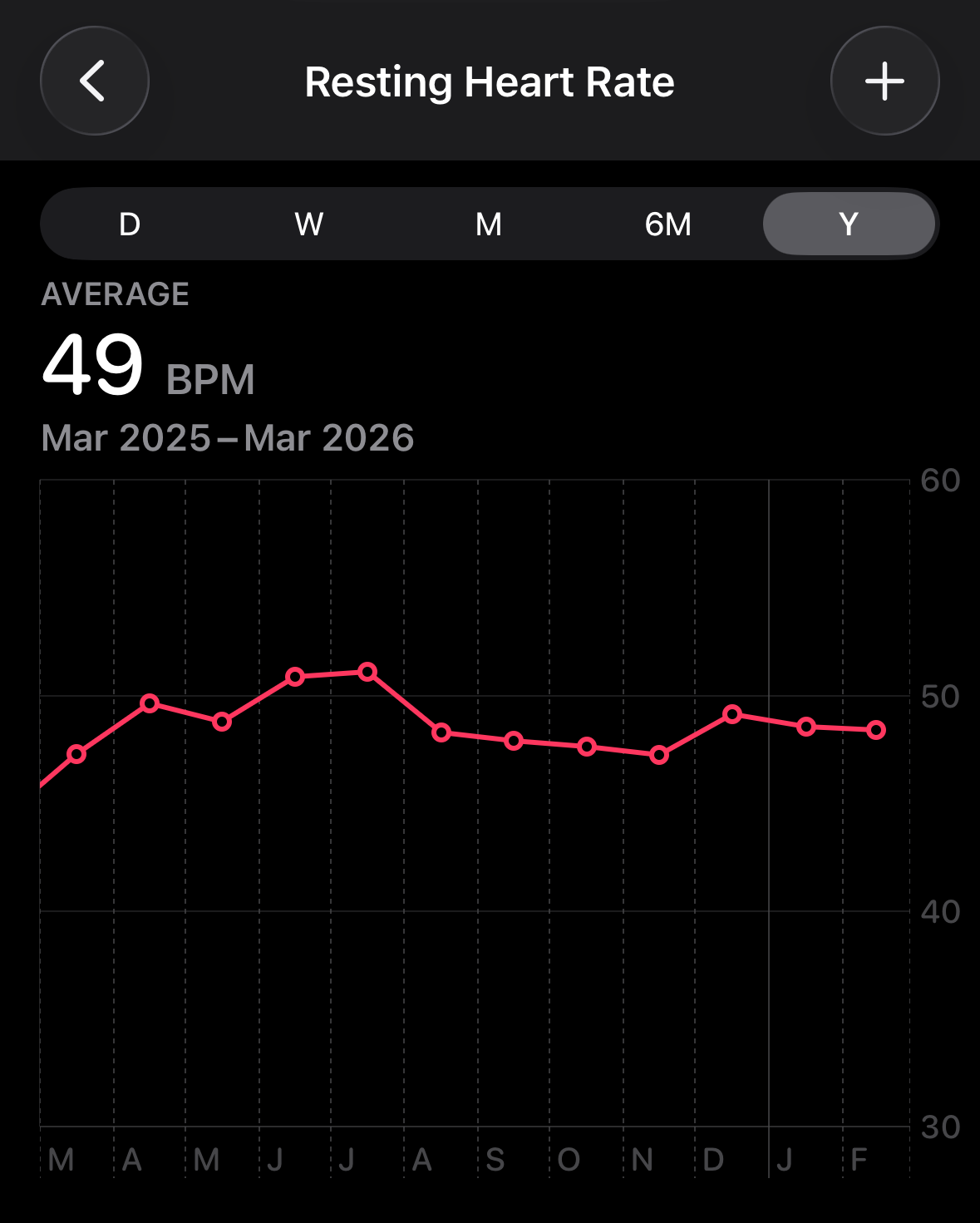
I wear my smartwatch on a daily basis so this metric has been recorded for me for years now. I generally have a look every three months but as you can see it’s been pretty consistent. If you never tracked it, it’s a good idea to have a monthly routine and then you switch to a less proactive approach like mine.
Your weekly tip: Keep an eye on your heart health. Track your resting heart rate at least once a month and aim for around ~60 bpm. If you’re consistently >80 bpm, consider seeing a doctor to review your personal situation.
Don’t forget to share this tip with a friend whose heart you care about 🫰
See you next week, until then…
Don’t Panic 😱
Your RHR is 49?! I don’t know what mine is right now (I’ll need to wait for my Pebble Time 2 to arrive in April…) but in 2023 (last time I wore the Whoop) it was 62. And I don’t think it’s ever been lower 😅